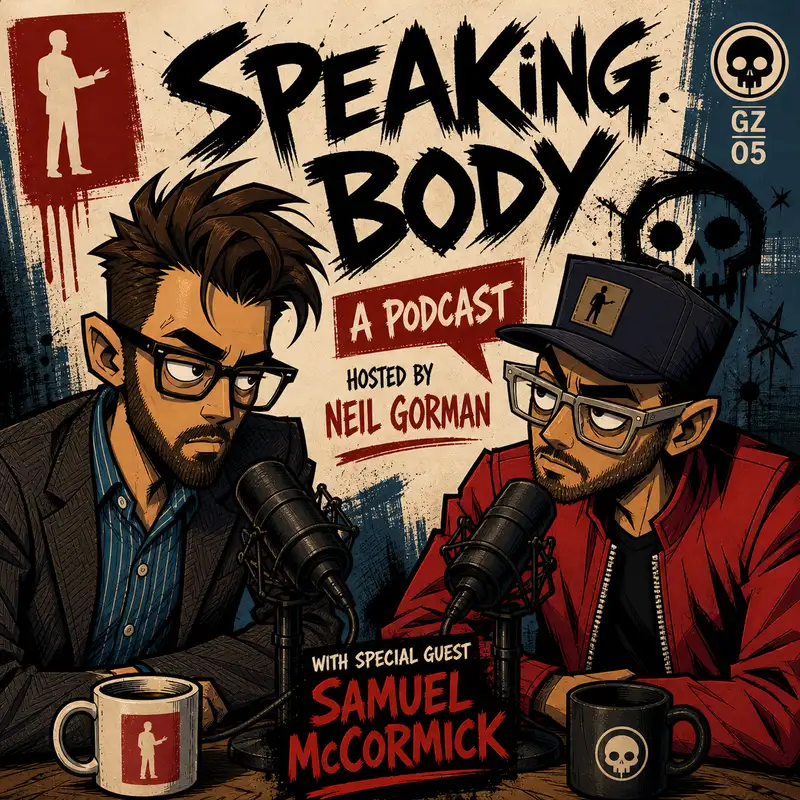
Sam Interview
Edited Transcript
Neil: Welcome to The Speaking Body Podcast. I'm your host, Neil Gorman. What I want to do now is set up and maybe explain a little bit about the episode that you're going to be listening to because it is different than the more recent content that you've heard on this podcast.
When I relaunched this podcast I did a lot of thinking about what I wanted it to be. And one of the things that I definitely wanted it to be was a tool for me to have really interesting conversations with really interesting people. That's one of the best things about having a podcast is it gives you this excellent reason to send somebody whose work you admire an email saying, "Hey, I have a podcast and I would really like to talk to you about the work that you're doing." And I made a list of people whose work I admire, people who I wanted to talk to on this podcast. There was a name very near the top of that list, and that name is Sam McCormick. Sam was on the list of people that I really wanted to talk to because of a project that he's been doing for some time now called Lectures on Lacan. The thing that I admire so much about Sam's work is that he is somebody who, in my opinion, rigorously engages with Lacanian texts, he does the work. He sits down, he reads these things, he really, really thinks about this stuff. And then he takes what happens when he tries to read these texts and make them make sense to him. He shares that, and the effect of him doing this is to. Render these Lacanian texts in a way that is very thought provoking for me.
I first sent Sam an email asking him if he would be a guest on this show back on February 23rd. I know that because I just pulled up my email program and looked it up. Sam responded really quickly to that email and said that he'd be down, and then the schedule non-report asserted itself.
Did you all hear what I just did there? I took the term sexual non-report, which is a really big term in Lacanian psychoanalysis, and I played with it a little bit. I turned it into the term schedule, non-report, schedule, I just want to make sure that you all heard that correctly.
Anyway It was really difficult for us to schedule the interview time. My kids got sick and then I was on spring break and then he was on spring break, there was always something kind of getting in the way, but finally we made it work. Our schedule synced up. We made the Zoom call happen.
Now I had prepared for this interview. I had questions. I had typed them up. I had them on a screen in front of me. I was ready to go I had a plan. But
as many of you know.
There are only four rules you need to remember. Make the plan, execute the plan, expect the plan to go off the rails, throw away the plan.
Pretty much right away I had to throw away my plan because. Sam didn't want to do a very formal, stuffy kind of interview. He wanted to have a conversation, and right away he started to have a conversation with me. He asked me questions. And I went with it. I decided to hell with my plan. I don't want to do that. I want to have this conversation with this extremely interesting person who has very graciously given me some of his time. And that's what we did as a result, what you hear is going to be a little less organized, then what you've been hearing so far, which have been these kind of tightly organized solo episodes where I have a very specific point that I'm trying to make. Hopefully you will all enjoy hearing this conversation to the same degree that I enjoyed having it, because if that happens, you're going to enjoy it a lot.
So without further ado, I give you my conversation with Samuel McCormick.
Sam: So, fascinating project that you're up to. And it sounds like you were a professor doing the professorial thing. And then babies started appearing. And you said, you know what? I'm going to run the clinical route and the dad route, and I that is so cool. You don't often hear of professors moving on. Once we get locked in, we stay. To see somebody prioritize family over a professorship is incredibly meaningful, wildly unique, and very impressive. So I applaud you from one father to another. Good work, my brother. That was great. Tell me about that part that seems just so, such a big life change. How did you manage that?
Neil: Okay, I got a, my doctorate in clinical social work and I was adjunct teaching through that process, and the guy who was the chair of my dissertation committee became the chair of a search committee when somebody retired.
And he said, you should apply for this position. And I said, okay, I'll do it. Why not? I was doing clinical work, I thought. This probably won't pan out, but why? I'll give it a shot. It'll be worth it.
Hmm.
Neil: And I taught high school before this too. So I was a high school history teacher for a number of years, and then I was doing the adjunct teaching and it worked out.
They ended up giving me a job and I was like, oh, great. So I stepped away from clinical work for about three years completely. because I wanted to really dedicate myself to teaching completely. And I thought, I can't do dad and clinical work and teach. So clinical work went away after about three years, I thought, okay, I can do a little bit of clinical work.
So I started to do some of that and I'm teaching about clinical work, so that also is relevant to the teaching. So I keep that going a little bit, but very minimally. And, by the time we had our third kid, I sat down with my boss because there was certain things that were happening. And I, I'm going to assume that maybe you have a version of this happening in your world too.
One is online education is increasing, and the model of online education that the university I worked at used was asynchronous, completely asynchronous, which I had a real hard time with. I'm not good at that. I got tenure. I sat down with my boss and I was like, look, I'm going to have my third kid. I didn't like teaching online and I said, this isn't working for me. So that's what happened with the university. We parted amicably and stuff, but it just didn't work anymore.
Sam: Well, every part of the story that you have described strikes me as very common.
I'm seeing it a lot, especially among, our two community colleges and the like, especially since COVID low enrollments,, asynchronous struggles, stuff like that., But the one part of your story that's very unique is you walked away and I think a lot of faculty right now are, are struggling because they don't see walking away as an option. So it's very amazing and wonderful to hear that, that for you was an option and that you were able to step out of a, I mean, it's, it just takes the fun out of it. It takes the meaning out of it when you're online and asynchronous. Like you don't even see students, you know, like maybe you record some stuff and then share that with them. You know, I remember thinking about this in terms of lectures on Lacan because when the series got started, everything was live. In fact, it started in the classroom where people just started recording this stuff. And as it migrated into a more online learning environment, I kept it live. So all the lectures I delivered those live with minimal notes and then had people interjecting and jumping.
And that's why you could hear like in my lecture series on seminar 11 or the drive. You hear people chiming in all the time and you probably know who some of these people are. So it was fun. And I liked that part a lot. But over time it seemed to make sense more to balance it out. So now I record lectures and share them with registered participants in any given series, and that's asynchronous.
And I don't know how I really feel about that because when I teach my classes, like yesterday I was in the classroom that's all live and without notes and I really vibe on that environment.
So it's kind of odd, like lectures on Lacan is kind of hybrid now. So we deliver lectures, remotely and asynchronously, but then we meet every other Friday for what I call a pissing while, it was a unit of time back in the day, but it was a however long your bladder takes.
In this case, my bladder and my bladder can go about five hours. And so like in our last series on Seminar 23, I don't know, 60 to a hundred people, not all of them could make it all the time and not all could stay for each session, but folks would show up and we'd stay there for five hours live online.
And I feel really juiced by that because I learn a lot from them. The vibe is good, and that kind of fuels me to go on and do the asynchronous stuff. Mm-hmm. But I think if it was just all asynchronous, it would become very turnkey. It would lose a lot of the energy and I would find it much less rewarding. Although I welcome an asynchronous class every now and again in my San Francisco state schedule, because it gives me some time to like focus on my in-person teaching. If I had all asynchronous, I think I would find the job really deadening. I miss the live component. And even though obviously you're in Chicago, I'm here in San Francisco, I still like that this is live.
At least on my end, I've got a, a, a pen and, and a pad, a paper. So I like being able to just, meet with people, talk with them about these materials, materials I feel very passionate about. But yeah, man, I get it. That asynchronous thing is like the nail in the coffin
you know, I just, I feel for my colleagues who are in your situation, but who don't have the exit route that you have. Me too. And it's a really, I don't think people fully realize, that how challenging of an environment that is for people who, have made their careers teaching and working with students and for whom that's really meaningful. It's like telling a dog walker that they're not allowed to walk dogs anymore, but they still have to drag leashes all around the city. I don't know, maybe that'd be fun for a minute, but after a while it'd get a little tedious..
Anyway, I digress. I just want to say I'm really impressed and so psyched that, that you're working on this emphasis on the experience of psychoanalysis as something that we live, something that we practice. And I agree with that. That was a 100%, well, I'd say 50%. Honestly. How I got into Lacan was just becoming a father and thinking to myself, okay, I don't know what I'm doing here, but I know I'm going to be a dad.
And I remember I called my brother too, and this is for the lower half of the graph of desire. And I asked him, I said, you know, bro, what am I going to do here? This kid's going to come out. I got no idea what I'm doing. He said, oh, it's easy. It's easy. Only four things, you know, like if it cries, you change its diaper.
If it's still crying, you give it some food. If it's still crying, you try and help it get to sleep. I said, well, shit, what's the fourth thing? He said, well, if they're still crying after that, you just call the doctor.
That simple. I said, oh, okay. Okay. So he, the big other had all the answers, for me in that moment. But at the same time, I knew I wanted to do something more. I knew I wanted to do something better than what, my parents had done. And so I thought, okay, who in the history of the Western tradition has really got fatherhood dialed in? And parenthood generally, who's got a non developmental approach that's super smart about how kids develop? And I had just finished my second book, the Chattering Mind, that had a third part in it on Lacanian psychoanalysis. And it wasn't all that I was interested in. The first part was on Kierkegaard, the second part was on Heidegger, and the third was on Lacan. Lacan was just one of many thinkers that I was working with.
And I thought, God, you know, I kept encountering this stuff in my research on Lacan where he's dealing with these things like the paternal function and the father and the Name-of-the-Father. And I'm like, this is really fascinating, as my pregnant partner is kind of like wandering around. And that was really the turning point for me when I started to think, okay, I really like this thinker.
He seems very relevant to parenthood. Maybe I could get some tips from this. So there I am, I'm reading all the parenting books,, alongside Écrits. And I started teaching more and more on this stuff and most of my classes drifted in this direction.
I also at the time was teaching, clinical doctoral classes at Pacifica Graduate Institute, and that gave me a real opportunity to scale up some of these materials. And the rest just kind of unfolded from there. But really one of the reasons why I took this call and why I'm so excited to talk with you is because I see in your approach to psychoanalysis as a lived experience, something that's not just occurring in the clinic and not just occurring in the classroom, but something that you get in your bones and that just kind of goes with you, whether you're on the bus or taking the kids to school or working in the yard or whatever.
And I think that is the way to live as a Lacanian beyond the classroom. It's beyond the clinic. This is a way of being in the world and I find it actually, the most useful mode of being in the world. This is how I've always evaluated thinkers that I've worked with. How useful is this thinker?
So, for instance, I went through a phase where all I was reading was the work of Emmanuel Kant, and I thought Kant is very useful. I was learning German, I was doing all, all my k, just explained everything. And then I got into Hegel and I was like, oh shit. Hegel really gets into it. And so I'm using all these thinkers and I'm looking at how much of my life they can help me make sense of without hesitation.
I will say that the work of Jacques Lacan has helped me make more sense of more parts of my life, and including the parts especially that don't make sense, where sense can't be made. Lacan also helps me deal with that. Lacan equips me to deal with what doesn't make sense.
Neil: Mm.
Sam: We can call it the real, we can call it variations on the real, but when things don't make sense, he's somebody that helps me deal with that. I don't say make sense of it, but deal with it. Mm-hmm. And I see that as aligned with his clinical work and L’Étourdit for instance, he says the goal of psychoanalysis is to hold a place for the real, just until something better comes along.
And he means clinical. The clinic is designed to hold a place for the real with the the end, but just until something better comes along. Mm-hmm. And what do we do with the real whose place is held? He says, we deal with it, we don't make sense of it, we fucking deal with it. And I've always liked that approach.
That's one of the things that has really stuck with me is learning how to deal with stuff. Existentialists kind of had this down, but I think Lacan takes it to the next level. In fact, that tradition from Kierkegaard to Heidegger to Lacan I think is one that has an increasing imperative on learning how to deal with shit. Anyway, long story short, long way of me saying mm-hmm. I so admire what you're doing, and it resonates deeply with, my own approach in many ways.
Neil: That's very cool. It reminds me, I can't remember which seminar this is in right now. I wish I could, but there's a distinction that Lacan makes between savoir-faire and savoir-y-faire the difference between knowing how to do something versus knowing how to deal with something, and Yes. The emphasis being that psychoanalysis is a practice that tends towards the second, right? Yes. I mean, there's lots of problems that you can get answers to by learning a thing, right. You don't know how to, change a tire. You can learn that, and then that's not a problem for you anymore.
Sam: Mm-hmm. Neil: Other things that doesn't work that way,
Sam: That's such a bone deep insight to how at least Lacan sees his work, especially in the later, later period. He thinks that.
He thinks that Freud discovered the unconscious, but that as Lacan says, the real is his, the real he says was his symptom, his symptomatic response to the Freudian discover of the unconscious. And I find it really interesting because for Lacan, the unconscious is a savoir-faire. It's an, it knows how to do things.
lalangue is a how to do and so is the unconscious. It just knows how to do stuff. But the real is something that we deal with. And so I think that that distinction that you're making between knowing how to do and knowing how to deal really captures well Lacan's own stress on the Freudian discovery of the unconscious and then the Lacanian discovery of the real.
And in fact, there's a pretty momentous, event in Seminar 23 and it's top of mind for me. I just finished our lecture series on Seminar 23, so I'm still kind of thinking about that and thinking about a lot of the stuff that the community brought forward. But one of the things we talked a lot about was this moment in the text where Lacan even says that the real is his sinthome
it's his special little thing. Yeah. So I love that. I don't know where he comes up with the, how to deal with versus how to do. It's probably in the early seventies. because I think that's where the savoir-faire understanding of the unconscious alongside lalangue really starts popping up.
Neil: Yeah. I want to say it's very close to the end. I think it's like twentyfour or something. I could be wrong about that. Even better. yeah. Anyways, A lot of the stuff that you've said has put a bunch of stuff in my mind that I want to kind of return to here. In a somewhat more systematic way. We'll see how this works. So, Sam: I'll do my best to upset your system.
Neil: I love when people do that. That's the best for real. All right i'm going to turn it over to you to introduce yourself, because I find that I am not the best introducer of people. So why don't you introduce yourself and introduce the project that you're working on, and we will take it from there.
Sam: Okay. So first, just, just to be clear, so we've been chatting here for about 20 minutes, and is this, is that going to be part of what's going on or is this right now what the beginning is?
Neil: I don't know.
Sam: All good. All right. So yeah, my name's Sam McCormick. I am the host of Lectures on Lacan. It's a newsletter. It's a podcast. It's increasingly becoming other things, which I can't announce quite yet, although I hope to very soon. I'm a professor of communication studies at San Francisco State University.
I sometimes do other gigs in clinical psychology, but for the most part, I teach upper division undergraduate students at San Francisco State, and I teach them Lacanian psychoanalysis. So if you're ever in town and you want to swing by and I've got a class going, you should definitely pop in. I get folks coming in all the time, and it's a completely wild and interesting environment to see 20 something highly urban kids working with Lacanian psychoanalysis. It's the most brilliant group of students I've ever worked with, and I've taught all over the place, all over the world. The kids at San Francisco State, it's why I took the job. They're fabulous. So, first and foremost, I'm an employee of the State of California and a professor, in communication studies at SFSU.
But this lecture's on Lacan thing is a weird, interesting spin out of that project, and it's where increasingly a lot of the satisfaction and enjoyment that I experience as a teacher. Come out. And it's also where a lot of my work as a scholar has been channeled. So I increasingly am turning down writing opportunities.
I'm just not as interested in writing. I've published, I've done all that I've, but increasingly for me, I enjoy sitting down with a pen and a legal pad and a whole bunch of colorful markers and doing the work of drawing and building lectures. I just find that the, something about the pace and the mode of handwriting really works well with how I think.
I don't have to write in complete sentences. I can draw weird diagrams, strange mnemonic devices that help me get going, and I really love that. I absolutely love that about lectures on Lacan. It has developed into a pretty fascinating learning community. It's truly global. There are, I don't know, I'd say probably 15 or 20,000 folks in the mix across various social media platforms and our substack and all this kind of business. And I host these online, lecture series where we just focus on trying to read Lacanian texts in a way that's clear, coherent, and accessible. And I've been very surprised at the appetite for this. In so-called Lacanian circles. I have a sense of why that is coming at this as a scholar, I've met many, many Lacanian professors and graduate students in my day.
98% of them don't know their ass from a hole in the wall, but they make it really annoying and challenging. So I love how Neil, on your website, you've got some emphasis on every now and again, you're going to hear me use fancy words. Now you're in Chicago. I'm from southern Indiana. We used to call those $20 words.
Neil: Yep.
Sam: When I'd go home, my grandfather would always say, oh, here he comes, Dr. Flimflam with his $20 words. Hey, Flimflam, give us a $20 word. Everybody wanted those $20 words. Unfortunately, the Lacanians have too many of them.
Neil: Mm-hmm. Sam: And most folks who bandy about these $20 words in my limited experience, I'm not saying I've got a statistically sound set here.
But they suck. They don't know what they're talking about. And what's really tragic about this is not just the time that we all lose listening to people who don't know their Lacanian ass from a hole in the wall. It gives the Lacanian tradition a very bad name to even say that you're a Lacanian to anybody in the humanities, is to basically announce to them that you're going to be indecipherable.
Make no sense, but pretend like you understand it all. It's this really weird thing where you simultaneously have zero humility and present yourself as an utter idiot.
What a remarkable clustering of things. So I think part of the reason why lectures on Lacan has really taken off in these ways. I think our podcast has some, one of my assistants said it had like 300,000 downloads or some shit like that. It's ridiculous. I don't even quite get how that, I don't know, I just do this stuff. I don't know what the rest of it amounts to. But what I do see a lot of is folks who show up and who say, listen, I've tried being in different cartels.
I've tried being in different reading groups. I've always looked for a podcast that could break this stuff down for me and not feel patronizing. I've looked for communities that I could be in and just ask dumb questions and actually realize that they're actually quite brilliant, blah, blah, blah. So in this community, people have been coming out of the woodwork.
We've got clinicians of every stripe, not just Lacanian. One of my favorite, clinicians that I learned so much from in the early years, was a Bionian. And she just showed up. She was a retired Bionian and just showed up and rocked the house. Not everybody's a Lacanian. Not everybody's even a psychoanalyst.
In fact, we've got a lot of professors. We've got a lot of students, a whole host of independent learners. Who just find this stuff fascinating. And I love this because it's like, it's like being in an art community where nobody's been discovered. Even though, and it's kind of weird like this, the people who have been discovered, they register for the series, they support me I so appreciate them. They know who they are. But I love the folks who just come out of nowhere and they've been reading Lacan in the Dark and they've been trying not to get suckered into these commentaries and interpretations that they find kind of ridiculous. And so they show up with these really unique and odd angles.
Like my favorite, the French Deleuzians, that show up at lectures on Lacan are so fascinating. Actually I'll take even an American Deleuzian. Shout out to my buddy Dan Smith and everyone he turns out. But these folks are great because they're coming at Lacan from these really unique angles. Just for example, Lacan stumbles around potentiality. Well turn a Deleuzian loose on the question of potentiality.
What you can do capacity, and it's coupling with impotentiality. The magic word in Lacanian world is castration. He gets castration, but he doesn't see it in the modality that it registers as, which is Impotentiality. But a Deleuzian comes in, understands potentiality and impotentiality dunamis and adynamia, but then also understands virtuality. Because lectures on Lacan has become this open door policy, folks who have been studying Deleuze and virtuality all these years can show up and just start turning little screws in Lacan's projects and suddenly things are crystallized and clarified.
They're not trying to be Lacanian. And that I think Neil, for me, is a really big difference here. It's the folks who are trying to be Lacanian, which is to say, trying to seem Lacanian. That I think have turned off many, many great minds from studying this work. So again, like the reason why I'm excited to be here is because I look at your project and I say, ah, here's somebody who knows all the fancy words, who can use the fancy words, but is not dedicated to that.
Dedicated instead to living a psychoanalytic life, living as a Lacanian. It's the experience, not just in the clinic, not just in the classroom, not just on the page, but in fatherhood, in parenthood, in partnership. I mean, there are all these ways where reading Lacan helps you be a better person. I think I'm a better partner reading Lacan
Mm-hmm. I know I'm a better dad, I think. I don't think there's any mode of my life where I'm worse for having read a Lacanian. Sometimes I will say this, and maybe you can resonate with this as well, and I bet some of your listeners can too. Sometimes reading Lacan, it makes me very sad and tired to be around people.
Sometimes I just, it just, it feels like just too much. I don't know how to say this except that when I walk around San Francisco, I mean, there are a lot of people here, and I talk with people in my neighborhood and so forth. Sometimes I just see pain. I see people that are uncomfortable they really don't know what to do and how to relieve themselves and how to bring themselves into happier situations.
I don't say happiness, but into better, relationships, into better understandings of themselves and the like. And I see that sometimes, and I'm not a clinician, I'm just a measly old professor. And it just makes me sad. It makes me want to like, not go out as much. It makes me want to wear sunglasses more often.
Earbuds wear a hoodie like this and pull it up over my hat. It makes me want to grow my beard longer. You feel me? It makes me, I guess, let me be very clear about this. What I see that troubles me as a Lacanian is not pain. What I see is suffering. I see groups and individuals that are resisting pain, they are resisting enjoyment, I would even say.
And we all talk about how we like to pursue enjoyment no matter what. And I don't know about that. I see a lot of people working very hard to avoid anything like enjoyment. And I see that coming through as a kind of suffering. Mm-hmm. That is how I understand suffering. Suffering is what happens when we resist pain.
And I guess as I walk around, I see suffering and I didn't use to see that as much when I was just studying. Like, I don't know the stoics. Even when I was reading Nietzsche, I didn't walk around and like see everybody suffering. Now that I'm studying Lacan and I emphasize the ING part there, I haven't read everything by Lacan.
Mm-hmm. So earlier you were talking about something that pops up I'm really stoked to see what's going to happen. I, haven't read Seminar 24. It's the next one that I'm going to teach and I will read it right alongside folks in lectures on Lacan.
It will be as new to me as it is to them. I hadn't read Seminar 11 before I taught it. Mm-hmm. So I really appreciate, what this community affords me in a world of suffering. I can be in a learning community where folks are curious, interested, doing their best, and grappling with significant text that everybody knows in their bones is meaningful.
And we just need to figure it out. And so I see on the one hand the tragedy of walking around my streets full of so much suffering, but then also on the other side of this, one of the areas of life that has become a lot more rewarding and fruitful and pleasurable even is working with folks in this online learning community, where I see an embrace of pain and a real dearth of suffering.
And I'm happy to be a part of that. It's a really, one of the, I would say it's probably the greatest honor of my career.
Neil: Hmm. Yeah, as you said, I'm really interested in the idea that psychoanalysis is an experience. This is a very important idea for me, that people can read Lacan and I believe they can gain a lot from the experience of reading Lacan tons. I have gained a ton. It sounds like you've gained a ton and you know many people who have gained a ton from reading Lacan.
And then if you go into for a clinical experience of psychoanalysis, that too is an experience and it's so unique to each individual person that you really can't communicate what happens in it. I think super well because it's just so idiosyncratic. But I think the experience of reading Lacan seriously and the experience of being an analysand in the clinic both aim towards getting people to be more attuned to aware of their subjectivity.
They become not less subjects, but more subjects. They become very interested in curious about their own dividedness, their own inability to say everything that they want to say in the way that they would like to say it. Their inability to communicate their subjective experience to other subjects in ways that those other subjects can hear and take in.
And in that way, it is a somewhat isolating experience. While at the same time this is a contradiction, but it seems true to me, it's also an experience that connects you to other people, because of course, they are living their own version of subjectivity, right? So we're all subjects, this is a universal, we're all divided. None of us can say all the things that we want to say about our lives. And so we all have that in common, but the way that each of us are experiencing that is completely singular and can't completely be shared. So when you were talking about suffering, I think what I see a lot of times is people rejecting their subjectivity, or at least attempting to reject that subjectivity in some way.
And that rejection of it is something that produces an experience of suffering for them. And I see this often as a very symptomatic thing. It's a thing that people do again and again and again. They get stuck in these loops. When I listen to people in the clinic, it takes a while for this to manifest, but at a certain point there's something that I hear that sounds like a certainty that they're asserting.
And when they assert that certainty, this leads to the drive as well. So somebody, this is a simplistic example, but somebody could think that people are basically untrustworthy. And if you trust people, they will inevitably betray you, stab you in the back, hurt you in some way. And then what happens is, that belief is there all the time.
And it's influencing them in all these different subtle ways. Sometimes not subtle ways, but they get involved in certain relationships. And then inevitably, the person, I'm using my fingers to do the air quotes here, betrays them because that could take so many forms. It could be something like they don't pick you up from the airport when you need a ride.
And it could be something like they betray your confidence and say something that's very private. It could take so many forms and then the person goes, ah, I knew it all along. I knew that this is how people were. And when they do that, of course they're suffering. They're hurting because they feel betrayed.
But at the same time, they're able to pat themselves on the back and get the satisfaction of being right about it. And now that certainty just reasserts itself. And I think that what happens in psychoanalysis is, for me anyways, from my own experience and as an analysand and an analyst, I think that when people become more aware of these things and the patterns that they create, the repetitions that they create they get a choice.
They could keep doing that. And some people do. They go, you know what? Yep, I'm going to keep doing that because I am not interested in changing it for some reason. I don't want to, okay. You can still talk about it, no problem. And other people go, maybe I don't want to do that. Maybe this isn't the way.
Maybe there's something else. I don't know what something else is. But I'm interested in finding out what something else might be. Mm-hmm. And this opens them up to, who knows what it'll be their thing, whatever it opens them up to. It's like putting a cut into the circuit of the drive. It's like hitting pause for a moment. It comes back. That certainty doesn't go away. And the circuit that it produces also doesn't go away, but the relationship that the person has to, it has changed.
That's how I see it.
Sam: Yeah. And I think that in the late sixties, early seventies, this is how Lacan sees it too. I think very much in, in seminar 17 and beyond, when he's really working discourse.
And I think what you're describing sounds a lot like a masculinized master's discourse, this radical denial of split subjectivity. And then through the analytic discourse, being able to historicize the masculine master. The masculine master is the one who really, I think, struggles with certainty.
And I don't mean to say that I'm speaking of men here, of course, masculinity for Lacan, right, as we all know, is a mode of enjoyment. It's a way of being, doesn't matter what's between your legs, it matters how you enjoy. So you could have a biologically female masculine master. It's just a way of being in the world and nothing to do with biological anatomy or sexual sex in that regard, but this push towards certainty.
It reminds me of the, Lacan kind of jokes about this, I think in, L’Étourdit about the masculine subjects attempt to naysay the phallic function to say no to language, to say no, to, this register of enjoyment that the masters is, tragically lured into, a phallic enjoyment where everything always comes up short.
And to say, no, I don't do that. I'm the big dog. I'm the one who says no to the phallic function. And Lacan's joke with this is in order to say no to the phallic function, by the sheer fact that you're using language, you plug yourself right back into it. You can't say no to language. It's one of these bizarre moments where the masculine subject is turned on its head.
It's like this kind of, it's this integral foundational contradiction, but it does come from this pursuit of certainty. There's going to be something that I can truly and utterly refute. I don't know, man. I feel for those, I feel for those folks. Mm-hmm. But I also believe that. In the analytic discourse, which is another thing that Lacan says he discovered on Freud.
We were talking earlier about Lacan saying that Freud discovered the unconscious and Lacan had a symptomatic reaction to it. Lacan in the mid seventies is insisting that the unconscious is Freud's, but the real is mine. And so much so that he's even saying the real is my sinthome.
I think that's straight from Seminar 23. But in this case earlier than that, he's saying, ah, Freud discovered clinical experience. But I am discovering clinical discourse. The analytic discourse is mine. And it's really interesting because at this point, Lacan sees discourse as a game. It's each discourse is a little game that we play.
He's pretty explicit about this, I think in, seminar 19. A, the psychoanalyst knowledge is about the time when he starts this. Regardless, the analytic discourse though is this really powerful thing that Lacan thinks he's discovered. And it's powerful, especially for working with subjects, I think like the ones you're describing, because what it does is it allows aggressivity to be directed in the clinic at the very part of self that the masculinized master refuses Barred subjectivity.
So if you draw the analytic discourse, you see little a, this abject analyst in an aggressive position, relative assemblance or an agential position relative to this other, this addressee that is the barred subject. And that's the very truth that the masculinized master in all of their certainty can't bear.
And I've always loved this as a move because it allows analysand and the experience of, the clinic to work at allowing the voice of that barred subject to interject, to speak up a little bit more.
And in the case of dealing with, and I would say we're talking about neurotics here, according to Lacan these would all be in neurotic subjects.
You can historicize them from there. Now we entered the discourse of the hysteric, where now the barred subject is doing the speaking, interrogating their symptomatic statements here of certainty and wondering, what on earth does that tell me about the unconscious truths that command my life. So this kind of like discursive play that Lacan is making from the discourse of the master to that of the analyst, to that of the hysteric, I think is something that for him was a very bread and butter approach to dealing with neurotics exactly like the ones that you're describing, which suggests to me, as a professor, not a clinician, that this must be a very, very common thing that walks through your door as somebody who shows up with a fixed narrative and attempt to reject subjectivity.
And it sounds like your vision of, a successful treatment of one of these subjects is to help them become more barred as subjects and to really embrace, maybe even learn to love that part of them that can't fully be expressed or with which they aren't quite as certain. I think that's really admirable.
Is that, what some folks talk about as subjective destitution? Is that the end of analysis for you?
Neil: I'm not sure. So there's a lot of questions there too. I think that what Freud called Cure Laan called the end of analysis. And I think that what the end of analysis is for any specific person is going to be completely singular.
And so it, it's very difficult to talk about it within the Lacanian school there's this procedure called a pass where people will do that. I have not done that myself, but I've heard people's testimonies of their passes and so I have some, you know, level I guess of experience of that and insight into it.
But what you're saying here is really important. I think you mentioned this is potentially neurotic subjects that I'm describing. Yeah. If we're talking about a neurotic subject that subject's capacity to engage in like a dialectical reversal about this thing, this narrative of which they are certain is going to probably be something that's somewhat present or very present in the clinical work that you do.
And if you're dealing with psychosis, less so. where I'm at in my own thinking, and this is not how I've always thought about this, it's changed over time and it might change again in the future, but there's a lot of people in my. World and my Lacanian community, who will sometimes make a real big deal about the difference between neurosis and psychosis.
And I think that there's a lot of reasons to do that. The idea being that you, if you challenged the psychotic delusion or the certainty of the psychotic, the narrative that the psychotic has created, then you could take them from being an un-triggered psychotic to a triggered psychotic. And that would not be a good idea.
This is where people move to this thing called passage of the act, which is when they do things like try to end their life, try to end the lives of other people, it's very, very bad when this occurs. So you do have to be careful. But when I have worked my way through Lacan and I, like you have not read everything that he wrote, but I get the impression that by the time you get closer and closer to the end, there's this idea, and this is my reading of it.
So this isn't me saying this is what Lacan says, this is what I've intuited from reading him. That neurosis is just a form of psychosis, which is generalized and a lot of people share it, but it's a way of making things work in your life. The neurotic fantasy, the idea of the Name-of-the-Father
This is a way that the neurotic is able to make their life make sense and work and get through it. And there's a lot of similarity between people who we would say are neurotics and psychotics. They have a different way of doing it. They don't have the Name-of-the-Father, as in the definite article. They have a Name-of-the-Father.
Right. And it's a different thing, but they can still have something. And what is that something and how did they relate to it? This is something that's always an open question for me in the clinic. What are, what's going on here? What is this person telling me?
And when I'm working as an analyst and I think I'm doing a good job working as an analyst, what I'm not doing is figuring this out and then kind of grabbing onto that is some kind of certainty that I can now have.
I know that this person is neurotic. I know that this person is psychotic. I know that this person believes this. I know that this person needs that to not do that. I sometimes think those things, but I try to put 'em off to the side and instead engage the person based off of something that I don't know or something.
Even if I feel like I know I can introduce some lack of certainty. Am I sure about that? If I think this person's an obsessional, neurotic, could they not be? And it's always operating that way, right? It's an attempt, I guess maybe to embrace my own castration, my own lack of knowledge, and to remain in that analytic discourse where I am in the position of the agent, the small letter a, and I'm not making a demand by attempting to assert some form of certainty that I have figured out for this person.
What I'm doing is I'm saying things and I don't know what will happen when I say them, I'm going to find out by saying them, and if that works for a person, they keep coming to their sessions and we see what happens. I don't know if that actually addresses what you were getting at. So I hope that it's relevant in some way.
Sam: It does, and it's even more interesting because now I see the position of the analyst in this whole process from master to analytic to hysteric, and I think you are precisely in line with how Lacan. Conceives of the work of the analyst here as a fall, sometimes gradual, sometimes rapid from a subject supposed to know a big A with all the answers to this subject or object that's supposed to go, that's that little italicized a in the analytic discourse.
It's not simply just the cause of desire. Little a is much more robust of a term and multifarious than that. I think if we're going to really pin it down, it would be somebody who occupies that position the way you just described it as not working on the things that I think I might know, but instead working with the parts of this analysand that I don't know and I don't saying things where I'm not entirely certain what the outcome is going to be.
That kind of, humility, that kind of analytic humility I think is very close to what Lacan would describe as the final position of the analyst in a treatment of a neurotic, which would be little a as abject piece of trash. It's so much so that Lacan in television even refers to it as patte like a little pile.
You truly are a little pile there not knowing, uncertain, wondering who's going to step in you next. And I really appreciate that move because it allows Lacan to come up with a very profound theory of sainthood. And maybe this is a little too, speaking of delusional, the saint for him is not operating it in the mode known as caritas.
He says the saint for him operates in a mode known as trashitas and actually is a saint because they reject any such categorization for themselves. And I find that really terrific that at the end of an analysis, the analyst is simultaneously a pile of shit and for that reason, eligible for a kind of saint hood. And I think that's just a waste object. Exactly, that's exactly what he's doing with abjection in the early 1970s is he's shifting. I mean, little a, you can trace a lot of Lacan's thought just through the transmutation of little a in this period, in the early to mid 1970s, little a has gone from becoming a remainder, to something that really is, as you say, like a cast off rejected object.
Abjection is the word that he now uses for it. And I think that's just wonderful because it allows for his theory of the analyst to fully complete first model being that of a subject supposed to know matched only by the big other, and eventually winding up as an abject supposed to go to be cast aside, to be thrown out.
And I'm not saying that that means the, I've heard some clinicians say that the analysand at the end is going to storm out and say, I don't fucking need this anymore. Why am I paying all of this? But I think it does make sense from a Lacanian viewpoint to say that at the end of an analysis with a neurotic, they don't think it's worth it anymore.
Neil: That's an interesting one. And I think, there's a lot of people, I don't know how many, and maybe I'm wrong, maybe it's not a lot, maybe it's just a few. But there are some people who have reached the end of their analysis. And they keep going.
Sam: That's a real problem. Yeah.
Neil: I don't know, but it's a problem. It might be, this is one of those instances where I'm not sure if that is or is not. Good, bad right, wrong problem, not problem. I don't know. I think what happens is the analysis reaches its conclusion. When that happens. There's a lot of things that go on, but I think primarily there's a draining of the satisfaction from, a place where it was from knowing something.
You still know the thing, but it's not satisfying in the same way the jouissance is, in a way, taken out of it to a degree or transformed in a way, and that changes everything when people
Sam: very good. I think I agree with that tremendously. And I don't think we're alone, I think smart people who work in this tradition, Neil, feel the exact same way that you do.
So will you, can you say a little bit more about that, that kind of draining of jouissance? I think that's a really, it's a point that folks miss when un when trying to understand what an interminable analysis is.
Neil: I'm not sure that's the thing I can't say exactly, but there's this idea that, at a certain point, the analysis, we could say exhausts its clinical effects.
Sam: Mm. Mm-hmm. Neil: The clinical effects of the analysis are gone if, or very minimized. Yeah. But there's a reason you don't know exactly why you keep going. Is that, is the analysis just become a symptom? It could have, or is there something beyond that you're, you don't know what happens if you keep going and you, you really don't have even a hypothesis here. What will happen? Well, and the way I think about things, this is being open to a form of desire, a lack of knowledge in a way that can be productive in ways that I am not sure what they will be.
Sam: I could see that, nevertheless, analysis at some point stopped.
Neil: Sometimes I think the end happens in the office. Sometimes it happens outside the office. I don't think there's a rule about that. I think it can happen either place but I do think that what I have learned through my own experiences is that what happens in the office is truly just the start of something that gets you going and it keeps you going.
Sam: Mm-hmm. But
Neil: then you leave the office and you go back out into your life and there's an ability that you develop. I think over time, in the beginning, I'm speaking super generally here, there's a tendency to keep the analyst in the position of the subject supposed to know you keep free associating presenting your subjectivity, thinking that the analyst, without knowing that you're doing this right, but you're thinking that the analyst is going to deliver some doozy of an interpretation that's going to do something for you.
Sam: Mm-hmm. Neil: Sometimes that happens. The analyst does deliver doozies of interpretations and they do something for you, but they don't get rid of the problem. The problem persists, the repetition persists, the symptom remains. And then what happens is over time, I think people start to become more interested in their own subjective experience, and they start to take on the position of the analyst for themselves in a way, where they start to see things happening in their life.
And this is what I was trying to talk about earlier. They become more attuned to their subjectivity. And as they're more attuned to that subjectivity, what they're doing is they're noticing things about themselves.
Sam: Mm-hmm. Neil: And they're going, oh, wait a second. And instead of going, I know what I'm doing, I know why I'm doing it, they start going, what am I doing?
Why am I doing this? Mm-hmm. Is a shift from that knowing certainty, which can be very satisfying. And I put squarely within the realm of, kind of like auto erotic jouissance mm-hmm. Towards a mode of desire where you're now open to experiencing your lack of knowledge, not as a threat that you need to defend yourself from, but as something that can be very useful, interesting, generative in your life. Your unconscious does things sometimes, you know, it opens up and you get a little flash and then it closes up again. But you're able to detect those flashes and you're like, ah, something happened there.
Sam: Mm-hmm. Neil: And you don't try to just explain it away, like, oh, there's a reason why I did that thing. That wasn't just a mistake. no, no, no, no, no. I've done that too many times. For it to be a normal mistake that somebody does, I wonder what's going on there. You shift the whole thing and then, you know, the analysis can continue or not.
In the school that I'm a part of, if somebody does a pass,, you get this rank of analyst of the school and you get to keep it for I think three years, and then you go back to being just a regular AP, an, practicing analyst, which is really just being an analysand and in my opinion,
Sam: interesting. I think now I have a sense of how you might view the end of analysis, and I know that you are reluctant to say what that would be, but your description here of yourself, but also of how these things progress. It sounds a lot like, on the one hand you've got, you could have an interminable analysis where the neurotic subject has been historicized, and if you think about again, the discourse of the hysteric, you see the barred subject addressing their symptom, that's the S one.
And then dialect izing that symptom with unconscious knowledge. That's the S two In the position of product. What's produced as an object of surplus enjoyment for that analysand is look at how much I'm learning about myself. I'm interrogating my symptoms. I showed up, I told you about this thing that happened to me and look at what I've discovered about myself.
I've learned this, I've learned that, and it speaks to what Lacan would describe as the part of unconscious truth that can be said and can be known. It is said in the form of a symptom, and it is known through the process of hysterstization. But the dilemma there is that this little triangle that you see in the hysterics discourse where that part of unconscious knowledge that can be said and known is revealed, not just said, but also eventually known. It becomes an object of surplus enjoyment. And the analysand starts getting off on all of the little productions of unconscious truth revealed, look at this. Look what this dream shows me, and I've got another dream this week, and oh my gosh. And it puts us in this kind of Delphi, realm of know thyself.
And when I meet people who don't study psychoanalysis, but are smart people, this is one of the foremost things that they think of. They think that psychoanalysis has to do with making true that old Delphi maxim to know thyself. And the discourse of the hysteric shows just that symptom after symptom gets interrogated, put into conversation and an unconscious truth is revealed and the subject goes away feeling like, gosh, I know a little bit more about myself.
Neil: Mm-hmm. Sam: But the shift I heard in what you were describing is to the other side of unconscious truth for Lacan. The unconscious like truth itself is split. There's a part of it that can be said and can be known, but there's a far vaster part of it that cannot be said. And as such remains unknowable. It's what we would call an impossible unconscious truth.
And I think that there's something happening in between there in the third space, the gap in between those two parts of unconscious truth that is truly the place we hold for the real and encounter with that place where the analysand realizes, God, there's just so much more to me than I'm ever going to be able to learn.
Coupled with what you described earlier as a kind of draining of jouissance where they stop getting off on the production of unconscious truth that can be known, I think this is a really terrific moment. You fully embrace that there are parts of you that will never be known, that can never be said, and that these parts far outnumber the parts that can be known and can be said.
And where indeed do you have this insight, but in the gap between these two parts in this opening or this space between the unconscious truths that can be said and known and the unconscious truths that are impossible to say and impossible to know. And I emphasize this third space, because this is the threshold of the real.
The real for the analysand in Lacan's work toward the end here is an encounter with a threshold. A threshold on which they stubbed their toe, like the old medieval thresholds, this block of wood at the doorstep to keep the thh in so that the straw wouldn't go flying out every time the door opened. It was always something on which you could stub your toe.
It's not the real, it's the threshold of the real. And it's in that moment right there between the two unconscious truths that I think the hysteratization of the analysand ends. The jouissance that they get from producing new insights into themselves, fully drains out, and then they're left with an encounter that is truly an encounter with the impossible, not just the unconscious truth that can't be said and known, but also an encounter with the real, which is this unclosable space, an irreducible gap between the two parts of unconscious truth that command your life.
And I see that for Lacan as the real, benefit to be had at the end of a neurotics analysis they encounter the impossible and they say, fuck, there are things that I'm not going to be able to fix. There are things that I can't get in there and with any amount of responsibility and right acting resolve. And yet this is the part that I love the most, Neil, about what you said, and yet I must still do something.
Neil: Right.
Sam: That part,
Neil: you can act now without certainty. That's the shift. Yeah.
Sam: Now you must act in the face of impossibility. And I just, I love that.
I love that. It's a great insight that you come up with there at the end. And it does speak structurally to Lacan's thought. I think he spent, I'd say probably five or six years, just like puzzling this one out. But it's a really, really common, I don't know if you follow lectures on Lacan, but it's a really common one that we've been drilling down on for a while.
So language splits into these two realms with an irreducible gap in between Feminine enjoyment splits into these two realms with an irreducible gap in between the unconscious splits into these two realms. So also does truth. I think this is really well illustrated. When in the old days you would go to testify and you put your hand on the Bible and they say, do you swear to tell the truth, the whole truth, and nothing but the truth, so help you God?
And I've always wondered, why the fuck do I need God's help with this? Well, because it's impossible to tell the whole truth.
We need the divine. You would need something like the divine to intervene and tell me the whole truth about, for instance, everything you've done this morning since you woke up, you've got four kids, a busy life. Your situation is complex and moving fast. I don't think if we were on this call for another six years, you would be able to detail all the nuances that you've experienced in the past six hours or so of waking life. And I think this captures Lacan's point about all of these registers, feminine enjoyment, unconscious, the truth and language itself.
Completing an analysis, it took me eight years and I remember distinctly when it was done, and it was great. It changed my life. Some days I wonder if it changed it for better or for worse, but it was absolutely, it was absolutely a new path. Yeah.
You ask, I know you're curious about how lectures on Lacan got started and why I would dare do something like this, because I'm also a professor and I don't get paid to do any of this work. I mean, people donate to support the cause and, you know, like help me with my assistance and all that kind of business. I do it because, I had a great psychoanalyst. She was not a Lacanian. She worked with me for eight years and it radically changed my life. It helped me in so many ways and I was so determined to do whatever I could to give back to the folks who were doing that kind of work.
That lectures on Lacan really allowed me to not just, you know, reach a professional goal, which is to just create my ideal teaching experience, but to help me realize this very personal goal of being able to help people that help people. Mm-hmm. So, I'm not a clinician, but most of the folks that attend lectures on Lacan are trainees or established clinicians., It's the greatest, achievement of my career, and I would say remarkably enough. As somebody who is trained to be a nosebleed scholar and hardcore intellectual historian, it is wonderful to say that it is an achievement in the category known as service. And you as a former professor, you know this, oh yeah.
There's research, there's teaching, and there's service. Service is typically the grunt work of working on committees, of doing assessments, of scheduling classes. This though is a service. I love that. For me, the height of the work that I've done is in the category known as service, community service, professional service even.
I don't think everybody benefits from an analysis.
I don't think everybody needs a psychoanalysis. James Joyce didn't need a psychoanalysis. However, I think that many, many people who would benefit from a psychoanalysis don't have the wherewithal to find one.
Neil: That's a big one. I know that this is something that comes up in my clinical work because I'm very interested in what can be done to try to make an experience of psychoanalysis available to more people who could benefit from it.
Mm-hmm. Because like you said, it's not everybody, but there are probably a large number of people who could, but they don't for various reasons. Think that they could, right? Mm-hmm. Like they might say, there's not an analyst that I can go talk to, or it would be too much time, it would be too much money, too much time, and too much money.
If somebody who's hearing this is one of those people, I would say, don't be so sure. Reach out to some analysts, send them some emails, and see what happens., My experience within the Lacanian world is that Lacanians tend to be incredibly flexible with people and are willing to get creative and find ways to work with folks.
Mm-hmm. Now, it's not every Lacanian of course, but there's a lot of them who are. The second thing I would say, and this has come up, and I don't really know if this is the right thing or the wrong thing to do, I'm not sure, but I have had a number of people come to me saying that they want to do psychoanalysis, and then they tell me about their life.
And they tell me that they can maybe only come once a month and they could only pay me like $25 a session. That's their situation is. I say to folks in those kinds of situations, you need to get your life straightened out. And once that straightened out, maybe we could do psychoanalysis. But for psychoanalysis to work, I personally believe that a person has to have their life in a stable enough place that they can come regularly and pay something that would work for the analyst and for the patient if they can't do those things it's just not the right time yet.
Sam: I want to ask you about this. I have a buddy who's got a van, and you might know this guy., He is a Lacanian psychoanalyst,, and also very active in the publishing world, but he is got a van and in his van is a tent.
And when he hears that there's been a shooting on one of the streets in San Francisco, he hops in the van with some colleagues, drives to the site, pops up the tent and says, I'm here to talk. I know that for you, Neil Psychoanalysis is an experience, it's an everyday experience. I'm sure that it, saturates your home life and your daily life., Let's just talk about psychoanalysis in the streets for a minute.
Neil: Sure.
Sam: Is it possible in light of what you've just said about advising someone to kind of get their life in a stable place where they can pay more consistently or show up more consistently, or whatever it might be. What can you do as a Lacanian psychoanalyst in the streets?
You're at the grocery store, you're at the dog park, you're at the bike shop, you're at the gym. I'm thinking like micro interactions where maybe you've only got three minutes or maybe you've got 10 minutes. How about sitting around a Thanksgiving table and you've got family all around you. You have a pretty good bead on your parents.
Hell, they live in your backyard. I guess what I'm wondering is, do you see opportunities to do good Lacanian work when you're not in the clinic, but instead in the streets and maybe encountering people who aren't in stable situations, who really are in chaotics modes?
Neil: Yeah. I don't do the work unless I'm getting paid to do it, and that's a thing that I think is in place for a reason.
The fee is a part of the analytic work. Mm-hmm. Now, that doesn't mean that I don't. Think this stuff and then make use of my understanding and make use of what I've experienced as an analysand in my day-to-day life with all sorts of people who I come across, I do.
Sam: Mm-hmm. Neil: And that happens in a variety of different ways.
I think that the most general way that I do it is that people say a lot of things to me. Sometimes they're surprising, sometimes they're not. They're actually boring. And what I'm able to do, I think better as my experience from Lacanian psychoanalysis is be interested in other people. Really, that's what it comes down to. I mean, like, I can go to the hardware store and be looking for something. I can't find it. So I ask the guy at Home Depot, Hey, do you know where this thing is? He says, yeah, I'll walk you over there. I'll say, how long you worked at Home Depot? And he'll, you know, what's the weirdest thing that somebody's asked you for? There
Sam: you go. See, that's that where, yeah,
Neil: I can just be really curious about this person and maybe he won't want to talk. Maybe he's busy or he's got a headache and he'll give me the sign that says, I'm not interested in this conversation, then I'll get out of his hair.
But you know, you just try to be really interested in the folks that are around you and to not be super judgmental or moralistic about the things that they say. So I talk to people who have different political beliefs. There's some people in the area that I live that are very much on the right, and there's some people who are very much on the left, and there's people who are somewhere in the middle or on the left for this and on the right for that, whatever they think.
I just really want to talk to 'em about it. I don't need to change their mind about any of their political beliefs at all. And right now, some of my activist friends don't like this, but I'm not interested in changing anybody's mind. I'm interested in learning what I can about why they think the things that they think, why the things that matter to them matter to them.
And if they're willing to share that with me, it's a real pleasure for me to be able to converse with them in a way. And so that's kind of like the most basic way it comes into my life now, with the guy that you talked about here, who goes up and sets up places, this is something that psychoanalysis, I think, needs to pay attention to.
I don't know if you're, familiar with the Ambulatorium. Have you ever heard of this?
Sam: Mm-hmm. Neil: Yeah, so this was Freud and Sándor Ferenczi and Carl Abraham set up these free clinics for people in Europe. It came to an end once the Nazis came to power. But there's a continuation of that tradition, I think, in these things called CPCTs, which I can't remember exactly what it stands for. This is still only in Europe, I believe. Wow. But there are people who will basically see a patient for 12 sessions, and the what the patient pays is sometimes very minimal. I've heard of one person who works in a CPCT who said that the fee that she charged her patient was the patient had to get on the bus and come to the session and give the analyst the ticket., The ticket is not a piece of currency, right? Mm-hmm. But she actually did have to get her body on the bus, take her body to the session and physically hand this thing to the person. There's a story, I don't know if it's true or not, about Lacan, and I don't even remember where I heard this, but it was, he, somebody contacted him, a really wealthy French dude, wanting to come in for sessions, and Lacan sets it up.
They meet, they arrange the fee, let's just say it's a hundred francs, that he's supposed to pay Lacan. And at the end of the session, the guy says, all right, I'll have my secretary call your secretary and we'll arrange for the payment to be made. And Lacan says, I've changed my mind. We're not doing it that way.
Your fee has been changed to a single franc,, this is kind of how they work, right? The fee does something in, in this, and they'll see the person for 12 sessions. This way, at the end of the 12 sessions, the person can extend another 12. So it's total of 24.
And then that's it though, right after that, who knows, maybe they are done, maybe they go into a form of psychotherapy with another person. Maybe they go into a form of psychoanalysis with an analyst. But the idea here is that you'll work with these people for about 12 to 24 sessions, and you're working in a way which is an applied form of psychoanalysis.
It's psychoanalysis applied to a form of psychotherapy, and it's not pure psychoanalysis. And there's a great paper about this by Miller, I think it's called Pure Psychoanalysis, applied Psychoanalysis and Psychotherapy, which is online. It's free. People can find
Sam: it. Sweet. All right. That's a good citation.
Your listener's going to love that one.
Neil: Yeah.
Sam: It's a great, theme. If you want to talk more clinical stuff, I mean, I think absolutely the payment is crucial and I can see that conceptually why that would be such a fucking important part of this process.
Something must be given. Something must be paid. And I gather where you're coming from on that front.
Neil: It changes things, right? It is a professional relationship you have with this person. And in a way, the fee, does a lot of things.
One of the things it does is, in a sense, set up boundary.. And that's part of the arrangement. And it makes it what it is. It's different than other arrangements. And I do think it needs to be there. And that's part of why I say, if somebody's like, I can't afford to pay you, I think, well, your life, if your life can get to a point where you can't afford to pay me, and what that is, what it is for them to afford to pay me is variable.
Sam: Mm-hmm. Neil: But they have to be able to do that. And once they're able to do that, then let's talk again. I might set it up like, let's talk again in a month. Let's talk again in three months. Let's see where you are. Instead of just like, you know, get outta here or something like that.
But, it's an important part of it. That's,, the point I'm trying to make and belabor here unnecessarily.
Sam: I know that you see patients and analysands mm-hmm. In person. I know that you also see them virtually when COVID hit. I had an analytic buddy, who just went straight to the phone and I said, man, how can you do this?
How can you do this without being in person? And he said, oh, all I need is the voice. The voice alone. I can work with somebody. And I was really surprised by that. And I was surprised. Not because I know anything about clinical experience, but because I read Lacan and I remember very distinctly before Lacan starts talking about Encore, Encore, Encore, which we all spell, E-N-C-O-R-E, and associate with his famous 20th seminar.
He's talking about Encore, spelled EN space C-O-R-P-S, meaning InBody, it sounds like Encore. But what he's saying is InBody in Corporality, and he is mandating this in seminar 19 B or worse, he's talking about this as a requisite part of his practice, that in addition to payment. They must also pay with time and co-presence.
The analysand has to show up and physically enter the room and be there in that space, in body, in person to do the work. And I've always been struck by that. because on the one hand I hear my buddy who just resorted to the phone and said, that was enough. I did all of my major psychoanalytic work in person. I went to her office a nd I thought that was actually a very meaningful part of the process. I think that for Lacan, what matters about being there in person is not what occurs in the room, but what doesn't occur in the room.
So in these rooms, we've got sound machines blazing in the lobby, we've got the door closed. Anything could be happening. Hell, there's a couch that looks a lot like a bed in there too. Sometimes you could be fucking, you could be murdering, you could be fighting, you could be screaming.
All of these things could happen, but they don't. We just talk. And I find that really fascinating to me that the clinic, as I read it, just straight outta Lacan's work, it's a risky space. It's a space in which things can happen. Yeah. I never have heard of anything happening. I know things do happen, but what a fascinating aspect of this.
So it's not just about speech and addressivity and the way that payment plays into Transferential experience through speech and aggressivity, but it's also about the fact for Lacan that this body has shown up. And I know that Lacan manipulated this in some ways. Sometimes reaching out and touching Andana's hand sometimes, like in the case you describe of demanding that $1 be physically placed into his hand, one franc at a time.
Right. I wonder what your thoughts are on this, in this highly digital telemedicine age.
Neil: I'm trying to work him out. I don't know. I was actually talking with a colleague about this. I have a colleague who. Doesn't let people pay them through PayPal or Stripe or anything.
Like they actually have to hand them money but he thinks that there's something about that that is very important. I don't see it that way personally. Maybe I'm wrong to not see it that way. I really don't know. It's something that I think we're still working out in the clinical world here. What is the difference between a person bringing their real body to a place where it is in somewhat close proximity? It's in the same room as your real body.
Mm-hmm. Versus when they are an image on a screen looking at your image on a screen. When you have that mediation of the image versus when you have the phone and there is no image. It's just the voice. We don't know the answers. Or if people do know the answers, they're not me. I don't know the answers to these things.
I am very interested in discussing those sorts of things with people. Mm-hmm. And finding out what they think about it and saying things in response to that. If I have ideas and thoughts about it, I'll share them, but I can't claim to say I know something that I can say unequivocally about that. because I just don't have that at this point.
Sam: I think there's enough in Lacan's own work to support the imperative on a body being there in person. And I think it comes down to, I mean, if we're really just going to cut right down to the bone on this one, in the history of philosophy, we've got a large imperative on being versus appearing. And you can run a lot of, unfortunately, this is the tradition in which I was trained, and you can run a lot of the history of Western thought through this gyre of being or appearing.
And for Lacan it's a little different. He is a phenomenologist through and through in many ways, but for him, it's the difference between being and having. And for Lacan, what fundamentally we are talking about is being a body versus having a body. And I think he finally becomes clear about that in the mid 1970s, or at least in the stuff that I've been reading up through Seminar 23.
Having a body is something that works by way of specular image. That's what we see on the screen right now. We each have a body, but being a body is what you are in your brown chair. And I am in my green chair, and I think there's something real about being a body and something profoundly imaginary about having one.
Huh? If, if the goal of a psychoanalysis is to hold a space for the real, just until something better comes along, I think that work could be done more easily in person, where we're not just sharing time, but we're also sharing space, allowing for what I described earlier as co-presence, where we're both here in space and time.
Because when I show up to you in Chicago and we're in the backyard hanging out, talking this through, I'm physically there.
Neil: Mm-hmm. The
Neil: air that we're breathing is the same. If a bomb falls, it kills both of us. You feel me? Like we really do have, we share some stakes. Mm-hmm. There are some material stakes involved there.
I get to be a body in addition to having one when you and I are together in space and time. And so I guess I wouldn't say that it's impossible to do good Lacanian work just through the phone or just through Zoom, but I could see an argument made that says it's easier to do good Lacanian work when folks show up in person.
And honestly, I have to tell you, man, quoting here, one of my best buds in the academy, John Durham Peters, he's a media philosopher. And one of the things that he says is that, in an age where it's very easy to mediate. Our interactions through zoom, through text, through phone, and the like.
It's more meaningful when you actually walk up and knock on somebody's door when you actually show up and put the franc in their hand.
Neil: I have two things I think that come to me in response to what you're saying. The first thing is, and this maybe there's a proposal in this too, I didn't think of this until just now, but if you're interested in it, we can talk more.
There's some work that Miller has done on this that's really interesting. I think where he gets deep into what Lacan thought about being versus existing. Is how he uses the terms, right? Hmm. And he talks about the real as is something that exists. It exists outside of being, which is imaginary and symbolic.
That's where being resides isn't those registers. And so our identity is a form of being, I'm going to be a psychoanalyst, I'm going to be a professor, I'm going to be a dad. All of that stuff is imaginary and symbolic, but the body itself exists and that's a different thing. And, there's a lot about this and if you'd ever be interested in kind of going through that together.
I have some of the texts, not a lot of it has been translated into English, but there's some of it that has, this is from Miller Seminar that he would give when he was doing that. And I've found it really helpful to read through this stuff. And I think it's always more helpful for me. And it sounds like you're the same way to read through things with people.
Sam: Let's do it.
Neil: Because yeah. It's fun.
Sam: Miller's Point is very well support. I don't know Mill's argument. I don't study his stuff. But, it is very well supported in Lacan's own work where in his later thought, Lacan transforms being into what he calls para being, giving it a very imaginary sense in which you're always alongside this thing that you fancy yourself to be.
And when he says existence in this period, as you probably know, it's spelled ex-sistence. And what Lacan is trying to suggest there is that ex-sistance for him as real as body as you describe it here is always a standing outside or apart from it's exsisting. And I don't know how Miller splits that, but I would imagine that if he's going to have being versus existence, it's probably a sense of being that has been reduced, as I say, to para being, being alongside in an imaginary sense and ex-istence that has been interjected with a hyphen to make it ex-sistence, which is very much how Lacan still understands the real.
Now the real isn't the only thing that ex-sists. So, and we can run through the list really quickly. Phallic enjoyment, ex-sists, the imaginary meaning ex-sists, the real, the jouissance of the bard, other the symbolic. We can go on with the list of exs, but I love that you've put the body there too, because the body is something that would ex-sists as well.
I would say it predominantly ex-sists, meaning being a body is something that Lacan oftentimes referred to as life that would be meaningless. Mm-hmm. Not insignificant, but meaningless because it's beyond exsisting. Standing outside of. Meaning, yeah. And I get all this just by looking at a Borromean knot, you can, what he's doing with the Borromean Knot diagrams is showing you all these fields of ex-sistence alongside others that might be better labeled Para being.
So, there is some good support in Lacan's own work for the insight that you're bringing out. And yeah, let's read Miller on this. Let's do something. Sure. I'm down with that. Sure. That sounds fun.
Neil: Another thing, because you seem pretty open to crazy ideas here, so at some point I think it would be really fun to bring you out we'll try to figure out a way to make that work. Congratulations. Yeah.
Sam: I would be interested in coming out. Yeah, let's talk about it. Lemme check my schedule and see how that might look. I always love returning to Chicago. My first job was at Purdue University. And I miss it every time I talk with somebody from Chicago and I miss a lot of things about going to Chicago.
It's one of my favorite cities. And if it's going to be populated with Lacanians you can almost certainly count me in.
Neil: Your work is very well known here too, among the people. I don't know how aware you are of this or not, but this is one of the reasons I really wanted to talk to you so much and want to continue to talk to you at different points is people will come to the stuff that I'm doing, and they'll refer to something from one of your podcasts, from one of your lectures. They bring it into a conversation. And the stuff that they're bringing in is generally very productive, right. Every now and then you get somebody who I think maybe is saying something, and I don't think they quite followed your argument, but that's rare. More often I think what they're doing is they're bringing something in and it really enriches the conversation when they do.
So that's really fun. And you're having that effect on people. It's a really cool thing that you're doing. It's such a worthwhile project.
Sam: Oh, that's so sweet of you to say. And I'm really honored to hear that. I mean, my goal is really to., This is going to sound silly, but all I do is just read Lacan and just try and make sense of it, and then talk it through in ways that make sense to me, because I find him very puzzling.
And if other people are finding that useful and if they're bringing it up in conversations and it's moving conversations forward, God, what a delight to hear that. That's just, that's just heartwarming.
Neil: Yeah. The work that you do it is just reading Lacan, but it's your body that you are doing this with.
You're taking your body. That's true. You're sitting down with the books, the texts. You have your markers, and you're writing, your body's writing this stuff out, and then you're sitting down in front of your camera and you're saying your things, you're doing your synchronous stuff, your asynchronous stuff.
This is all a thing that for some reason you have decided that you will do this with your body. Mm-hmm. And that's not a small amount of time that you're dedicating to this. It's a, I think, pretty large amount of time that you've really taken your body and put it towards this. You could do a lot of other things, but you don't, you do this, this is a very significant thing.
It shows, shows one of the ways in which you are kind of paying with your body to do this work.
Sam: I like how you put that and maybe I'll pay with my body and get on a united flight and dare to return to O'Hare for a minute., In October. The Midwest and October's fabulous you have to get to San Francisco next.
Neil: I'd love to see San Francisco. It seems like such a cool town.
Sam: In the meantime, I know we've got just a few minutes. Is there anything that you wanted to talk about that we haven't talked about?
Are there any particular like Lacanian concepts or themes that just have been bugging you or that maybe we can work together tell me what I can do, man. Yeah, I've got some more time.
Definitely.
Neil: so one of the things that you've talked a lot about, which is this really helpful concept, the idea of a littoral zone, which you've mentioned mm-hmm.
A bunch of different times in different places.
One of the projects that I'm. It's trying to do, and I haven't figured out exactly how to do it at this point. It's something I'm going to call lab LAB Lacanian across borders. Mm-hmm. And what I really want to do with that is engage other people who have an interest in Lacan or maybe not, maybe they don't have that much of an interest in Lacan, but they have an interest in something else that crosses over. And I want to engage them in as much conversation as I can.
So that's something. But the idea of the electoral zone is a really big one.
Sam: It's such a great image. Yeah. It's a terrifically useful. I mean, Lacan's coming back from his second trip to Japan, and this is a very big part of literary, but also, the original lecture that he gave in Seminar 18 where he fleshes out this image of looking down at a geographic space and seeing a river kind of cut through a landscape and then expanding from there to the littoral zone. In terms of environmental science, as I did in my series on seminar 18, I do hear from a lot of people for whom that was a really resonant image., That's cool. And I love that you could maybe pair this with a professional initiative that would indeed find these borders so often determined by a river. I'm on board. This sounds fascinating.
Neil: Yeah. You're having these across borders conversations with people and seeing what they can produce. You know, Lacan's work is out there. People can do whatever they want to do with it. They might do something kind of cool, in which case, let's have a conversation. Why not? That's what happened when he opens the seminar up and with seminar 11 before it's all, you know, psychoanalyst and training at St. Ann's Hospital and then seminar 11 on it. Anybody can come. Let's open up,
Sam: you know what, and if you really do drill down on Lacan's weekends, what you'll see is that he is not hanging out with psychoanalysts.
He's going to his country house with mathematicians. He's hanging out with translators. He is surrounding himself with linguists, with topological theorists with proto-knot theorists. He's really working his ass off for sure. To work at intellectual borders and bringing people with insights from beyond into the clinical space.
So the idea that anybody would be so fetishistic as to insist on only having conversations tell them I want to debate with them. Tell 'em I challenge them to whatever debate and whatever situation they want. because I want to show them how much you can learn just by being on the outside or on the fringe or working with fringe folks to study Lacan. And I use the word fetishistic very precisely here. Yeah. Because I think that for a lot of folks, Lacan becomes a kind of fetish object. That for me is troubling. It's very troubling.
Neil: I really appreciate you taking the time here today.
This has been a lot of fun for me. I hope it was fun for you.
Sam: Truly.
Neil: And I hope that I'll get a chance to talk to you again soon.
Sam: Yeah, let's do more maybe in October, maybe exchange some papers, see what's going on. I look forward to it. You know what, I also love if, maybe someday you might want to jump on a call with lectures on Lacan and meet some of these LEDs that I work with.
Neil: I would love to man.
Sam: All right. See you brother.
Neil: Bye.
Sam: Bye.